The perfect alignment? Will all eight planets ever line up
Every few years a headline promises that “the planets are aligning”. Seen from above the Sun, they never are. The eight planets orbit at unrelated speeds, so the best they ever manage is to bunch into a wedge, and the tighter the wedge you ask for, the longer you wait. This page puts numbers on that, from the orrery’s own 6,000 years, from 20,000 years of JPL data, and from a two-million-year computer integration built for this question.
Short answer. In the 6,000 years from 3000 BC to 3000 AD the tightest grouping of all eight planets is 40° wide, on 21 August 1596 BC. In 20,000 years of JPL data it is 39°, on 27 May 5753 AD. In a search of two million years it is 17°, around February 863337 AD. A grouping within 10° should happen about once every 40 million years; one within 5° about once in 2 billion years, which is comparable to the age of the Solar System. A perfect line never comes.
What “aligned” means here
Picture the Solar System from above, the Sun in the middle, and draw the narrowest pie slice that contains all eight planets, Mercury to Neptune. The width of that slice is the figure quoted on this page. It is measured in heliocentric longitude, the planets’ angle round the Sun, which is what the orrery’s top-down view shows. A slice of 360° means the planets are spread all round; 180° means they are all on one side; 0° would be the perfect line, with every planet on one ray from the Sun.
This is a different thing from a planet parade, where several planets appear close together in Earth’s evening or morning sky. Parades depend on where the Earth is and happen every few years. A wedge seen from the Sun does not care where the Earth is, and the tight ones are rare.
The tightest groupings ever found
These two are the best in a two-million-year integration of the Solar System (980000 BC to 1000000 AD, described below). Each picture shows the moment twice: on the left in the orrery’s compact layout, where the angles are true but the orbits are squeezed together so the inner planets can be seen, and on the right at true scale with the distances log-compressed. Pluto is left out; it is far round the other side on both dates.
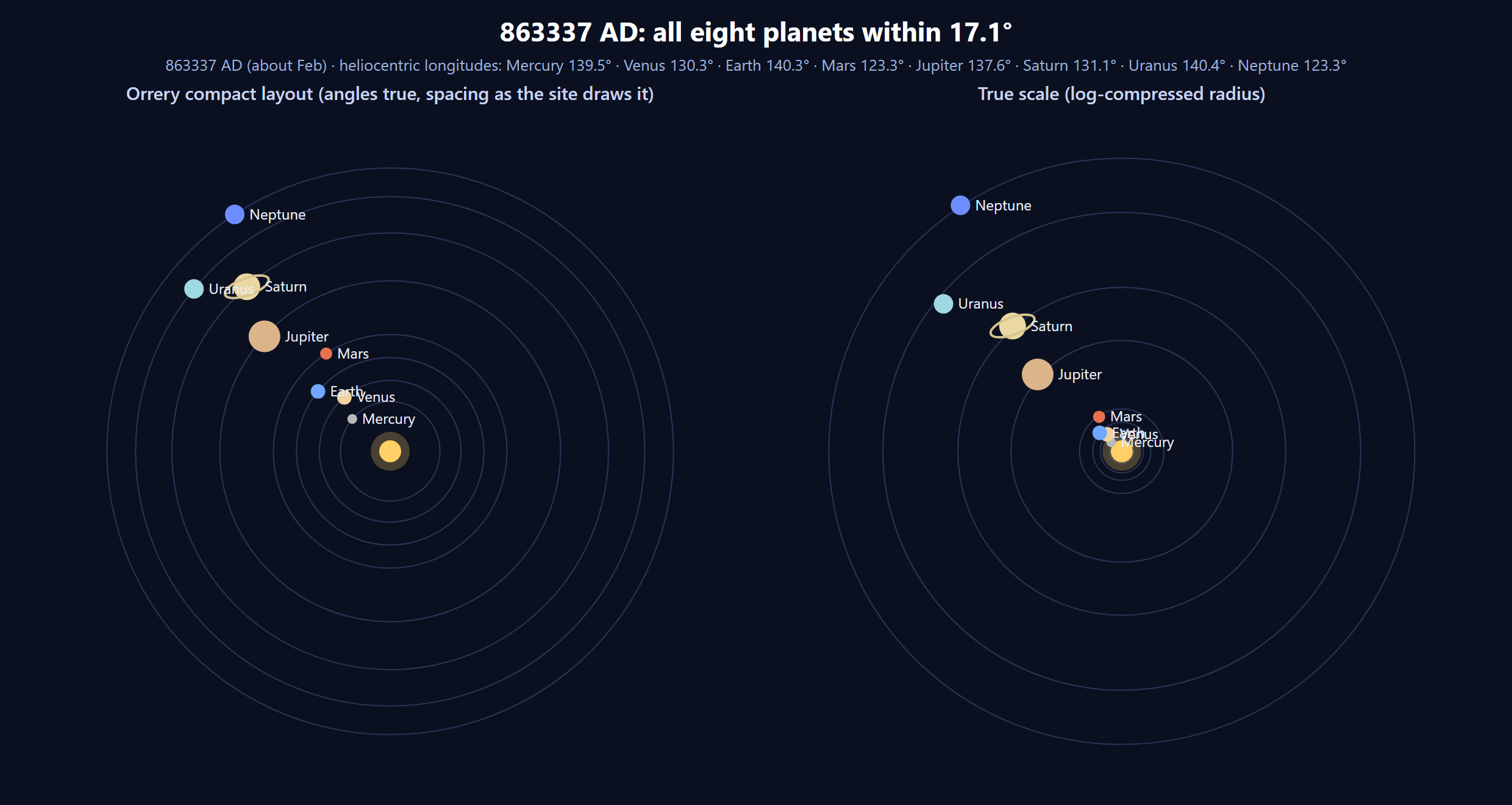
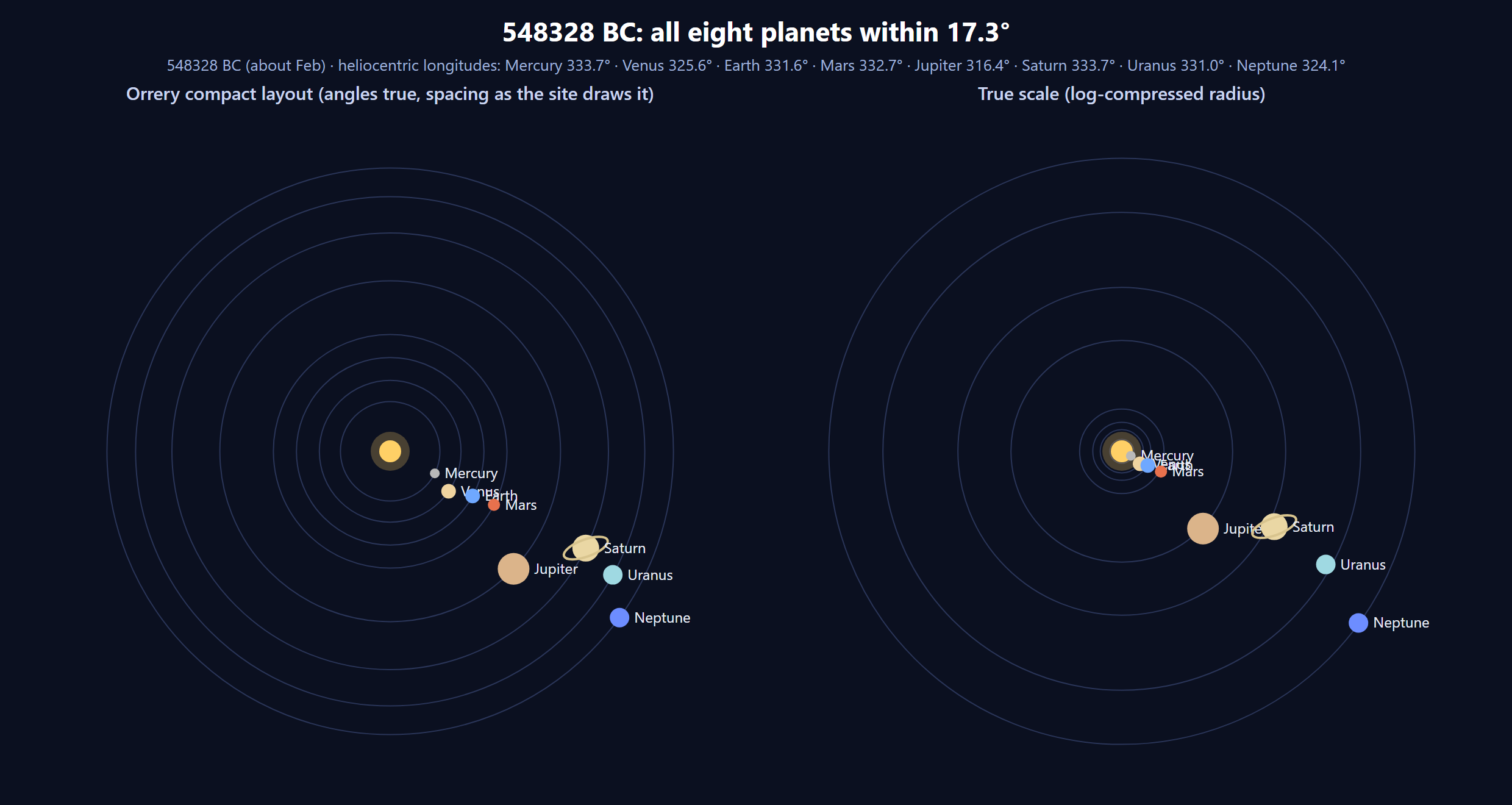
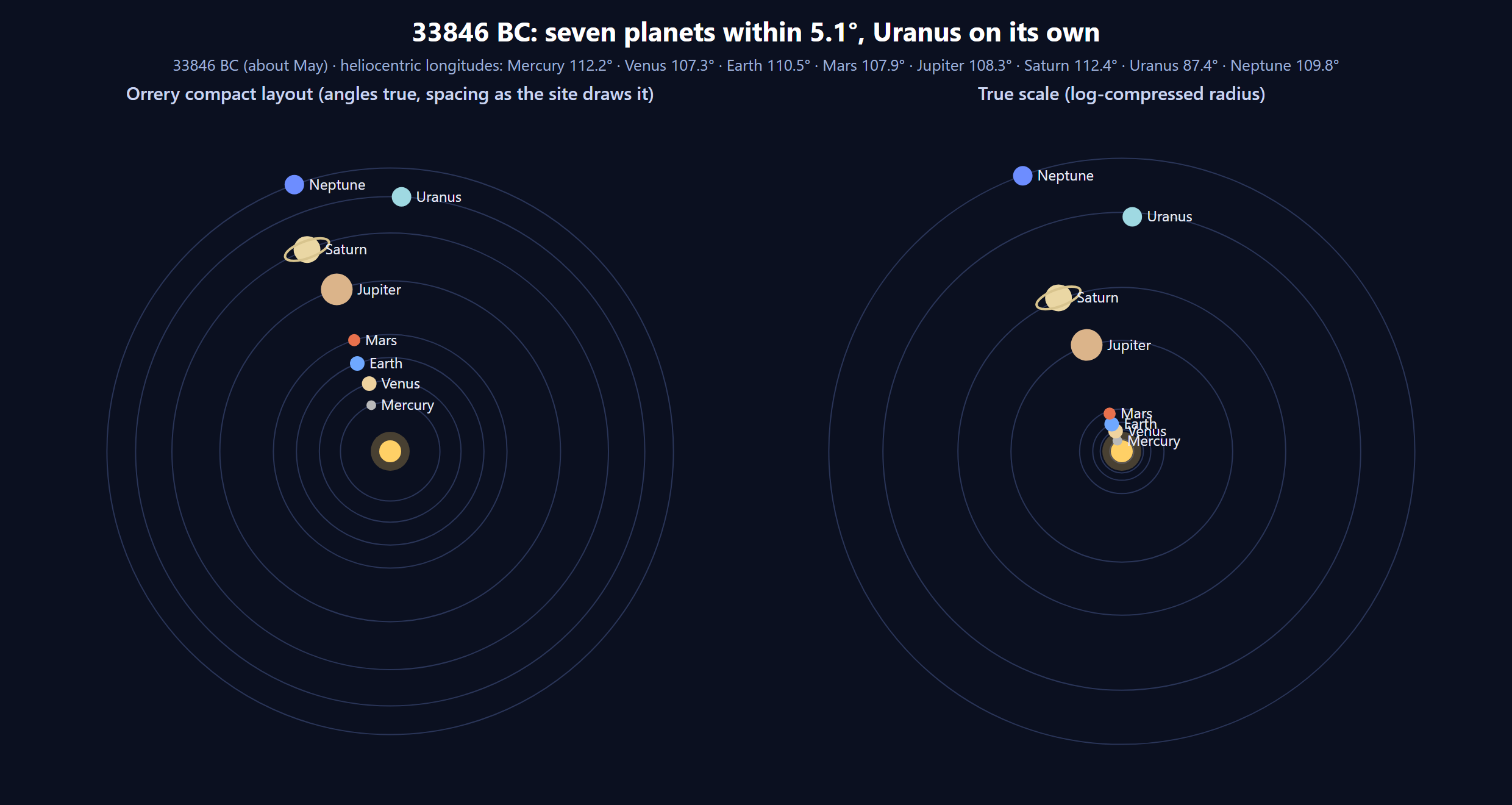
For comparison, the best the orrery itself can show you is 21 August 1596 BC, all eight within 39.7°, and the tightest to come in its range is 19 May 2161, within 68.8°. The JPL record for 20,000 years, 27 May 5753 AD at 39.35°, is just outside the orrery’s fitted range, so it shows with an “approximate” note, but the picture is right to a degree or two.
How rare is each level?
Counting every grouping in the two-million-year run gives a clean rule: the number of groupings tighter than an angle falls as roughly the sixth power of the angle. Halve the angle you ask for and you wait about sixty times longer. For eight directions scattered at random the theory says the seventh power, 8 × (θ/360)⁷; the measured curve is a little shallower because the slow outer planets keep the arrangement correlated from one year to the next.
| All eight planets within | Found in 2,000,000 years | Mean wait between groupings |
|---|---|---|
| 50° | 591 | about 3,400 years |
| 40° | 171 | about 11,000 years |
| 30° | 32 | about 65,000 years |
| 25° | 13 | about 150,000 years |
| 20° | 3 | about 700,000 years |
| 15° | 0 | about 4 million years (extrapolated) |
| 10° | 0 | about 40 million years (extrapolated) |
| 5° | 0 | about 2 billion years (extrapolated) |
The last three rows are extrapolations of the rule, not events anyone can date. The Solar System is about 4.6 billion years old, so a 5° grouping is something that has happened perhaps twice ever, if at all, and the planets’ orbits are chaotic over tens of millions of years, so no computer can say when. That is the honest answer to “when will the planets align”: for anything tighter than about 20°, never on any date that can be named.
The thirteen groupings within 25°
Every grouping of all eight planets within 25° found between 980000 BC and 1000000 AD. Years this far out are counted in Julian years of 365.25 days from 2000 (the calendar year would differ by up to 18 years at a million years) and the months are approximate; the years are solid, but see the note on accuracy below before trusting the exact arrangement of the inner planets on the farthest dates.
| When | All eight within | Note |
|---|---|---|
| 754582 BC, about October | 24.2° | |
| 610565 BC, about March | 21.6° | |
| 548328 BC, about February | 17.3° | Pictured above; the last time within 20° |
| 513355 BC, about January | 24.9° | |
| 473758 BC, about December | 21.5° | |
| 33846 BC, about May | 24.9° | Pictured above: seven of the eight (all but Uranus) within 5.1° that week, the tightest seven-planet line in the search; the tightest eight-planet grouping of the last 500,000 years |
| 172408 AD, about October | 24.6° | The next grouping within 25° |
| 276827 AD, about April | 23.2° | |
| 552665 AD, about March | 24.5° | |
| 657083 AD, about September | 23.7° | |
| 860755 AD, about May | 19.6° | The next grouping within 20° |
| 863337 AD, about February | 17.1° | Pictured above; the tightest in the whole search |
| 946306 AD, about January | 23.6° |
Between now and 3000 AD nothing comes close: the tightest is 69° in 2161. The next grouping within 30° is about 40726 AD (29.3°), and the next within 25° is 172408 AD.
Where the dates come from, and how far they can be trusted
Three different sources, each reaching further than the last and each less certain than the last.
- 3000 BC to 3000 AD: the orrery’s own model. The orrery computes every planet from JPL’s long-range Keplerian elements, which are fitted to the planets’ real motion over those 6,000 years. Within that span its positions agree with JPL’s full ephemeris to a few hundredths of a degree for the inner planets and about half a degree for Saturn and Uranus. The orrery will still draw dates out to about 9000 BC and 13000 AD, with a warning, and for the inner planets it stays within 0.3° even there; the giants drift by a few degrees, and Pluto, whose elements carry no long-period terms, becomes meaningless.
- 9999 BC to 9999 AD: JPL’s DE441 ephemeris. This is the same numerical ephemeris that spacecraft navigation uses, served by JPL’s Horizons system, and it is as close to ground truth as exists. Every event on this page inside that span was measured directly on it. The 5753 AD record and the 1596 BC and 1128 AD groupings come from here.
- 980000 BC to 1000000 AD: a purpose-built integration. To go further, the Sun, the eight planets, Pluto and the three largest asteroids were integrated forward and backward from JPL’s starting state with a high-order symplectic integrator, including general relativity, the Sun’s oblateness, the Moon’s pull on the Earth and the Sun’s slow loss of mass. Run across the 20,000 years that DE441 covers, it reproduces JPL to within 0.001° for every planet, which is the check that it can be trusted beyond. Its error then grows with time, and the table below gives the budget.
| Years from now | Mercury | Venus, Earth, Mars | Jupiter to Neptune |
|---|---|---|---|
| ±10,000 | 0.002° | 0.002° | 0.001° |
| ±100,000 | 0.2° | 0.05° | 0.005° |
| ±200,000 | 0.7° | 0.2° | 0.015° |
| ±500,000 | 4° | 1° | 0.07° |
| ±1,000,000 | 18° | 4–5° | 0.3° |
Most of that uncertainty is one number: the rate at which the Sun loses mass to sunlight and the solar wind, known only to about ten per cent, which shifts every orbit a little faster or slower as the square of the time. The giants, which set the slow envelope of a grouping, stay good to a fraction of a degree for the whole million years, so the years in the tables above are reliable throughout. What blurs on the farthest dates is where the inner planets sit inside the wedge: by 863337 AD Mercury could be anywhere within about 18° of where the picture puts it, which is as wide as the wedge itself. Read the two pictures as “what a 17° grouping looks like”, not as a forecast for that February.
Beyond a few million years the question stops having an answer at all. The inner Solar System is chaotic, with a doubling time for small differences of about five million years, so no starting data, however good, can say where Mercury will be in fifty million years. That is why the 10° and 5° rows above are given as odds, never as dates.
Try it in the orrery
The 3D orrery jumps to any date between 3000 BC and 3000 AD, and its Events menu lists the notable groupings in that span: the 1596 BC record, the 600 AD inner-planet alignment within 1°, and the spiral of 603 BC among them. Open an event, and the view glides to the top-down pose used for the pictures here.
See the 1596 BC grouping from above
Questions
Will all the planets ever line up perfectly?
No. The planets orbit at unrelated rates, so there is never a moment when all eight sit on one line from the Sun. The best they do is bunch into a wedge: 40° in 6,000 years, 39° in 20,000 years, 17° in two million. A 10° wedge is a once-in-40-million-years event and a 5° one a once-in-2-billion-years event, comparable to the age of the Solar System.
When was the last time the planets lined up?
The tightest grouping in recorded history was on 21 August 1596 BC, all eight within 40°; the last comparable one was in 1128 AD. The last time they were within 20° was about 548,000 years ago.
When is the next one?
Before 3000 AD the tightest is 19 May 2161, within 69°, which is not much of an alignment. The next as tight as 1596 BC’s is 27 May 5753 AD; the next within 30° is about 40726 AD; the next within 20° about 860755 AD. Planet parades in Earth’s sky are a different, far more common thing: see planetary alignments and planet parades.
How rare is a planetary alignment?
Within 50°, every 3,400 years or so; within 40°, every 11,000; within 30°, every 65,000; within 20°, every 700,000; within 10°, every 40 million; within 5°, once in 2 billion. The count falls roughly as the sixth power of the angle.
Does a planetary alignment affect the Earth?
No. Venus at its closest raises a tide on Earth about one twenty-thousandth of the Moon’s, Jupiter about one millionth, and the rest add less. Alignments have no measurable effect on tides, earthquakes or weather.
Why isn’t Pluto counted?
Pluto is a dwarf planet on an orbit tilted 17° to the others, and with a 248-year period it rarely shares a wedge with the eight planets. The figures here count Mercury to Neptune; the orrery shows Pluto too.
Sources and method
- JPL Horizons — the DE441 planetary ephemeris, used for every date between 9999 BC and 9999 AD and as the check on the integration.
- JPL approximate positions of the planets — the long-range Keplerian elements the orrery runs on, fitted for 3000 BC to 3000 AD.
- The million-year run is a Wisdom–Holman symplectic integration (the SABA₄ scheme of Laskar and Robutel, 2001) of the Sun, eight planets, Pluto, Ceres, Pallas and Vesta, with the Sun-source relativistic terms, solar J₂, an averaged Earth–Moon quadrupole and solar mass loss, started from DE441’s state at J2000 and sampled yearly. Its uncertainties were measured by re-running with the step halved, without the asteroids, and with the mass-loss rate varied by ±10%.
- Groupings were found by scanning the positions daily for the narrowest wedge containing all eight planets, refining each minimum to the minute. The same scan over the DE441 span and over the orrery’s own model gives the 1596 BC, 1128 AD and 5753 AD figures; the three sources agree to a few hundredths of a degree where they overlap.